
How to Assess Mold Exposure From Your AC
That musty smell when the AC kicks on is not something to brush off, especially when it keeps returning after you clean the room. To assess mold exposure, look beyond a single visible spot or a bad day of allergies. Pay attention to where symptoms and odors occur, whether moisture is present, and what happens when your HVAC system begins circulating air.
Mold can grow in damp areas throughout a property, but contamination inside an air conditioning system deserves special attention. Your HVAC system moves air from room to room. If mold is present near vents, coils, drain pans, or ductwork, it may repeatedly send spores and particles into the spaces where your family, tenants, employees, or customers spend time.
The good news is that you do not have to guess forever or jump immediately to a costly whole-property inspection. A focused assessment can help you identify warning signs, test the air system, and make a clear decision about what to do next.
How to Assess Mold Exposure at Home or Work
Start by looking for patterns. Mold exposure is not always obvious, and symptoms alone cannot confirm that mold is the cause. Seasonal allergies, viruses, dust, pet dander, and other indoor air issues can feel similar. Still, a consistent pattern around a particular building or when the AC runs is a useful signal.
Ask yourself whether irritation, coughing, sneezing, watery eyes, congestion, headaches, or asthma flare-ups seem worse in one area. Notice whether you feel better after leaving the building or spending time outdoors. If several people in the same home or workplace have similar complaints, that is another reason to investigate the indoor environment.
Next, use your senses. A persistent musty, earthy, or damp odor near supply vents, return vents, closets, or the indoor AC unit may point to moisture and possible microbial growth. The smell may be strongest during the first few minutes after the system turns on, because the air movement carries odors through the space.
Then look for moisture conditions that allow mold to grow. Water does not need to be standing on the floor for a problem to develop. Condensation, a clogged condensate drain, a leaking air handler, high indoor humidity, a past roof leak, or poor drainage around the building can all create the damp conditions mold needs.
Warning Signs Around Your AC System
An AC system naturally creates condensation as it cools air. When drainage and maintenance are working properly, that moisture is managed. When they are not, components can stay damp long enough for mold to take hold.
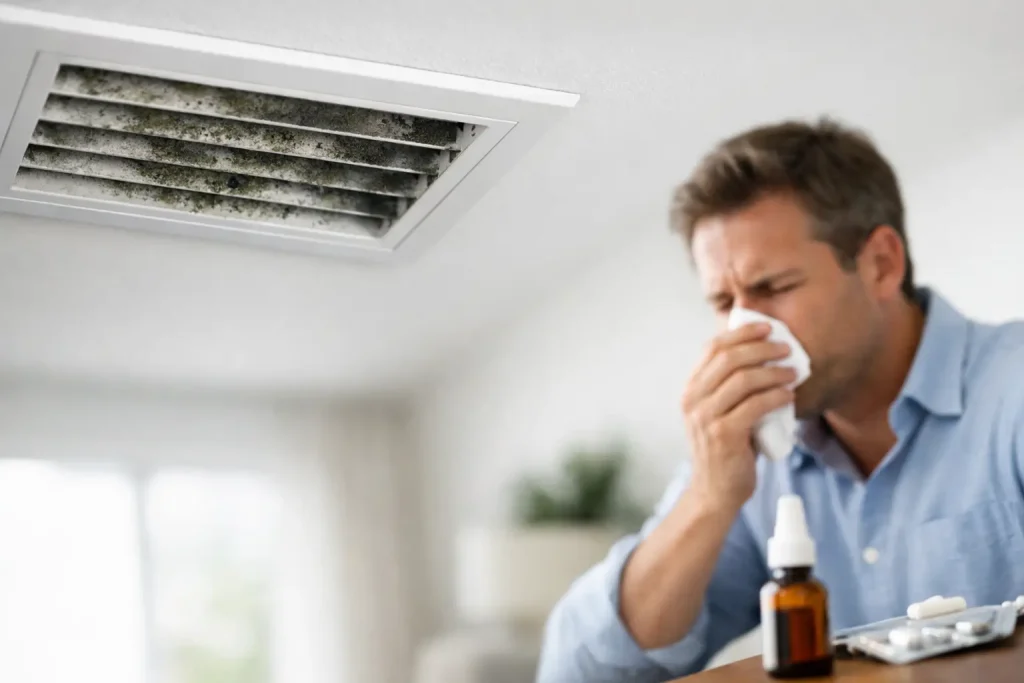
Check accessible areas without taking apart equipment or disturbing anything that looks heavily contaminated. Look around vents and registers for dark, greenish, gray, or fuzzy-looking spots. Examine the area near the indoor unit for water stains, rust, pooling water, or signs that the drain line has overflowed. A dirty filter does not prove mold, but it can indicate that the system needs attention and may be circulating more particles than it should.
Keep in mind that visible material at a vent is not always mold. It may be ordinary dust, soot, or residue caused by condensation. Likewise, mold can be present in parts of the system you cannot see, including the evaporator coil area or inside ductwork. That is why a visual check is useful, but it should not be the only step.
If a strong odor appears only when cooling is on, if spots return after surface cleaning, or if someone’s respiratory symptoms consistently worsen around the vents, move from observation to testing.
Test the Air System Before You Spend More
Testing helps replace uncertainty with a practical next step. A focused AC mold test is especially useful when your concern centers on the air coming from vents, rather than a known wall leak or a large visible mold area.
Clean Vent Air Solutions offers a simple way to check for mold contamination in the HVAC system without waiting for a broad, expensive inspection. The process is designed for everyday property owners: clip, combine, and cover. You collect from the relevant AC or vent area, follow the kit directions, and review results in about 24 to 48 hours. An optional lab report can provide additional validation when you need more documentation.
A DIY test is a smart first step when you need a fast answer, but it is not a substitute for professional evaluation in every situation. If there has been significant flooding, widespread visible growth, a major leak inside walls or ceilings, or a serious health concern, contact an appropriately qualified professional. People with asthma, mold allergies, chronic lung conditions, or weakened immune systems should be especially cautious and speak with a healthcare professional about symptoms.
The goal is not to panic over every speck of dust. It is to identify a potential problem early, before ongoing moisture and repeated air circulation make it harder and more expensive to address.
What a Positive Result Should Tell You
A positive mold result is a reason to investigate the source, not a reason to simply spray fragrance or wipe down a vent cover. Mold needs moisture. If contamination is present, finding and correcting the moisture problem is central to preventing it from returning.
Depending on the situation, the next step may involve HVAC service to inspect the drain pan, condensate line, evaporator coil, filter housing, insulation, or ducts. A technician can determine whether cleaning, repairs, component replacement, or duct remediation is appropriate. The right response depends on where the contamination is located and how extensive it is.
Avoid turning off the system indefinitely if the building is hot and humid. In many climates, lack of cooling can increase indoor humidity and create more favorable conditions for mold. Instead, address the system safely and promptly. Use a clean, properly fitted filter, keep supply and return vents unobstructed, and make sure condensation is draining as intended.
For renters, document what you notice. Take dated photos of visible staining, note odors and when they occur, and report leaks or AC concerns to the property manager in writing. For small business owners, records can help you communicate clearly with building management, maintenance providers, and employees.
When Symptoms Need Medical Attention
Indoor air concerns can be frustrating because the symptoms often overlap with common illnesses and allergies. Do not use a home test to diagnose a medical condition. If breathing problems are severe, sudden, or getting worse, seek medical care right away.
For less urgent but ongoing symptoms, note when they happen and share that pattern with a clinician. Information such as “my congestion worsens within an hour of the AC starting” or “my child coughs more in one bedroom” can be more useful than a vague concern about mold alone. At the same time, continue addressing the environmental question. Better information about the air system can help you make safer property decisions.
A Faster Path to Peace of Mind
Waiting for a stain to spread or a musty odor to become unbearable rarely makes the situation easier. If your vents smell off, moisture keeps appearing near the AC, or people feel worse when the system runs, start with a focused assessment. A quick test can give you a clearer basis for maintenance, remediation, or a conversation with a property manager.
Clean air starts with paying attention to the system that delivers it. Taking one practical step now can help protect your space, your budget, and the people who breathe there every day.